
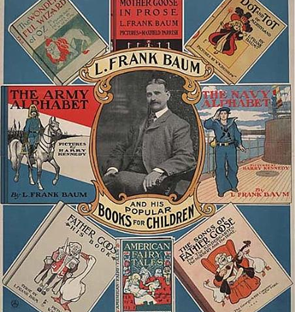
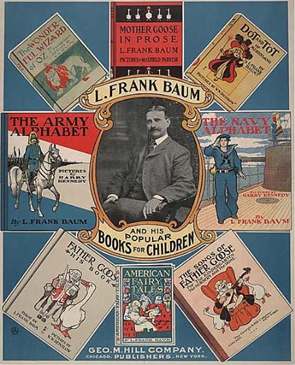
Image found at https://www.neh.gov/article/oz-americas-fairy-tale
“Though the best way to engage with great authors of the past is, of course, to read their work, there’s plenty to gain from visiting the places where they lived and scribbled. Touring writers’ preserved homes can help put their books in historical context or fulfill a quasi-religious need to pay homage to artists who speak to us with startling directness across distances and decades.” — Zac Thompson at Frommers.com
I have been fortunate to visit the homes of several authors. As Zac Thompson stated, such homages are a wonderful way to give the author’s books historical context, as well as to simply learn more about the person and pay respect to their talent. For those of us who love to write, those journeys may also be the sources of inspiration for our own work. Recently I made the trek to Coronado, California in honor of L. Frank Baum.
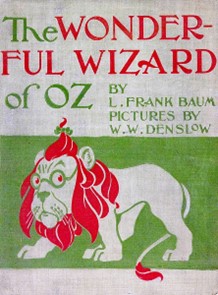
Image found at https://memory.loc.gov/cgi-bin/ampage?collId=rbc3&fileName=rbc0001_2006gen32405page.db
I have long been intrigued by the Oz stories of L. Frank Baum and the related, 1939 film “The Wizard of Oz.” In fact, these adventures became the inspiration for the structure of my middle grade novel Captain Con & the Red Jacket. As I began to write, the following words written by Baum in the first Oz story, The Wonderful Wizard of Oz, came to mind. “No matter how dreary and gray our homes are, we people of flesh and blood would rather live there than in any other country, be it ever so beautiful. There is no place like home.”
Dorothy’s adventures in Oz led her to the conclusion presented in the above quotation from The Wonderful Wizard of Oz. “No matter how dreary and gray our homes are… There is no place like home.”
Nick, the protagonist of Captain Con & the Red Jacket, also believes his home a “dreary and gray” place. Then, like Dorothy, he mysteriously finds himself in a strange world. Instead of an Emerald City, the fantastic land in which Nick visits is a world of pirates, sea battles, and dangerous voyages. Overcoming environmental obstacles and villainous encounters, the boy finally realizes “there’s no place like home.”
As Nick’s story clearly illustrates, L. Frank Baum’s work was an inspiration for my novel. Thus, I was excited to visit the place where Baum wrote many of the books in his Oz series. A visit to the place where L. Frank Baum “lived and scribbled” would allow me to pay homage to the author who still speaks “across distances and decades.” With this in mind, I traveled to Coronado, California where Baum lived for several winters and wrote four of his Oz books.
Coronado “Island”
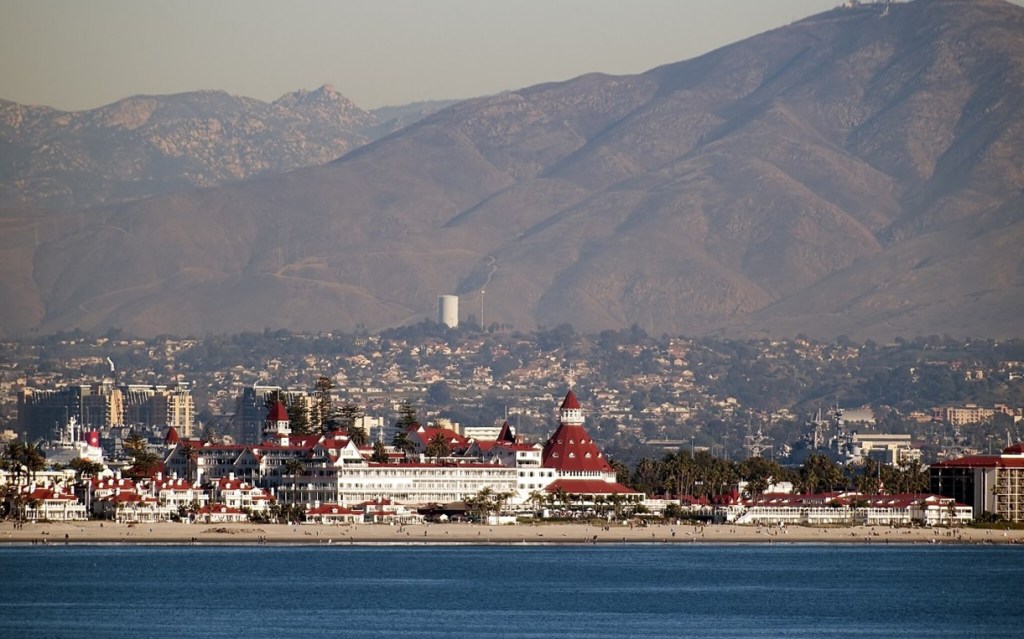
Image found at https://upload.wikimedia.org/wikipedia/commons/3/3c/Hotel_del_Coronado.JPG
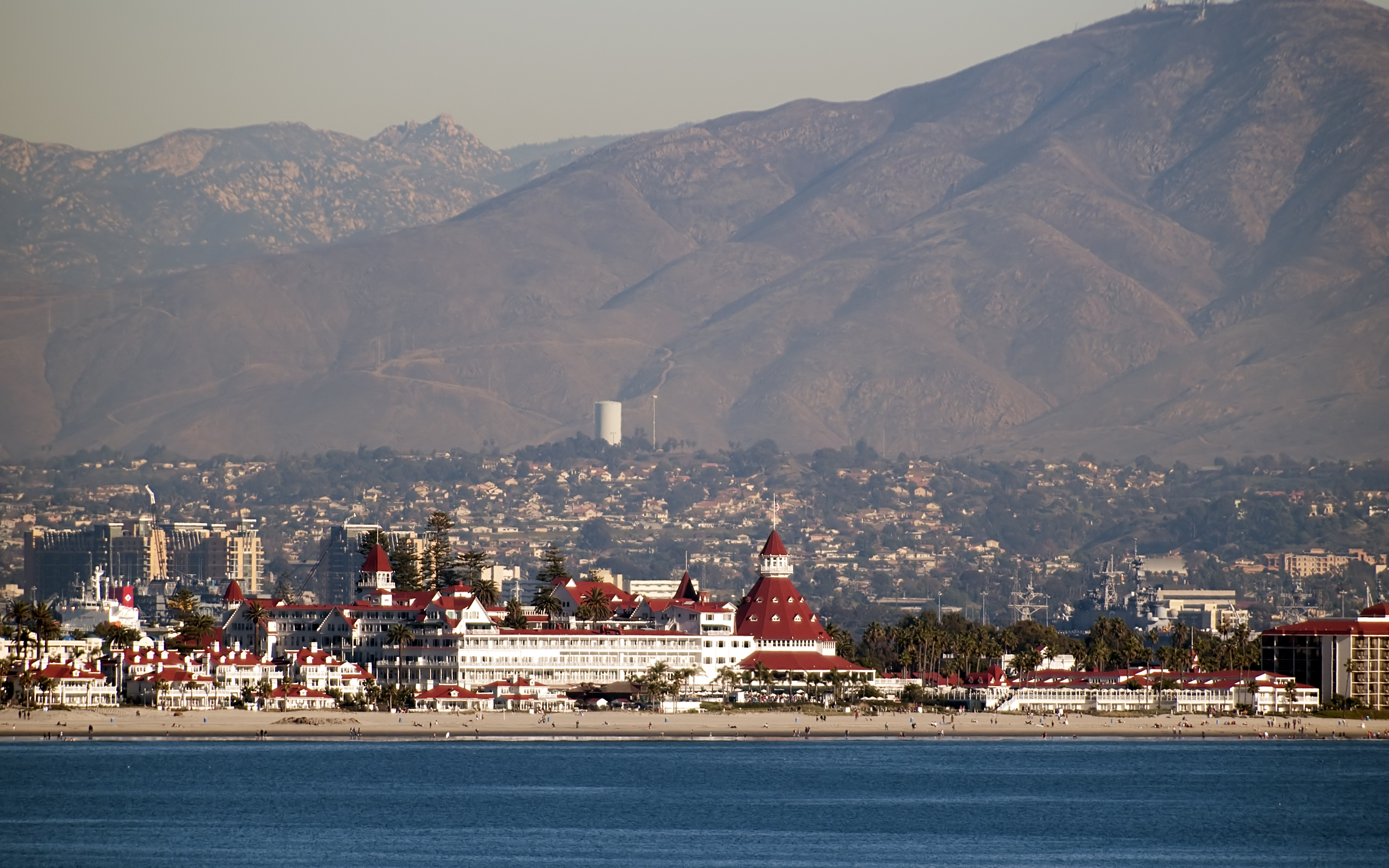
Coronado was first inhabited by people of the Kumeyaay tribe with the last six families deported to a reservation in 1902 which was 12 years after the town was incorporated and four years after Elisha Babcock, Hampton Story, and Jacob Gruendike built the Hotel del Coronado. In addition, the three organized the city and sold plots for settlers to construct homes. In 1900, John D. Spreckels established a tourist and vacation area where people could rent tents for vacation stays. Eventually he also bought “the Del.” His “Tent City,” that later gave way to cottages, remained until 1940. The hotel remains in its Victorian glory with additional structures added over the years.
Coronado is often called an island. Actually, it is connected to the mainland by a narrow piece of land, a sandy isthmus called the Silver Strand. So, it is actually a “tied island.” Coronado was mostly separated from North Island by the Spanish Bight, a shallow inlet of water. The North Island was developed by the U.S. Navy and led to the filing of the bight during World War II which combined the land areas into a single body. The Navy still maintains a heavy presence on both the north and south sides of the island. Over the years, the size of Coronado has increased because of dredge material dumped on its shoreline and accumulated naturally. In early days, people like Baum came to Coronado by ferry. Then in 1969, entrance to Coronado began easier with the opening of a 2.1 mile, five-lane bridge.
Hotel del Coronado
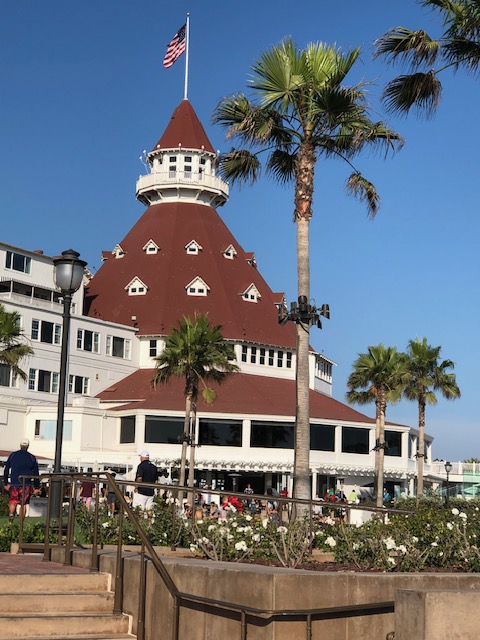
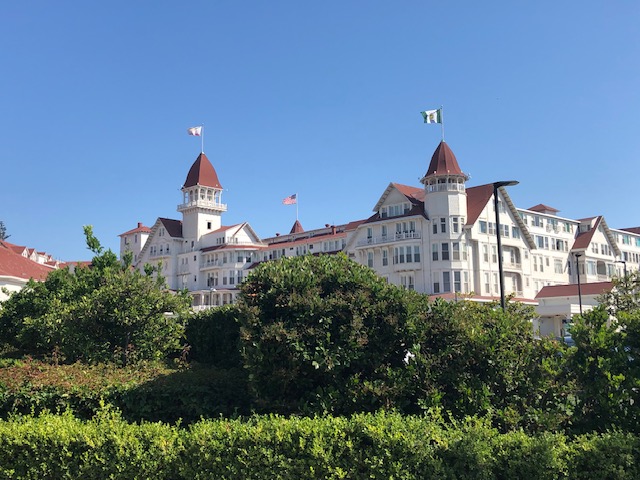
Images by PortiaLily Taylor
Four years after The Wonderful Wizard of Oz was published in 1900, Baum, his wife Maud, and their young sons left Chicago to spend winters in Coronado, where he continued to write Oz-themed sequels and other fantastic tales for children. The family stayed at the del Coronado Hotel which, at the time, was the country’s largest resort. The whimsical beauty of the hotel and its seaside location was said by Baum to be reminiscent of his novel’s fairyland. He loved the resort so much that he even designed chandeliers for the establishment in the shape of crowns since Coronado is Spanish for “crowned.”
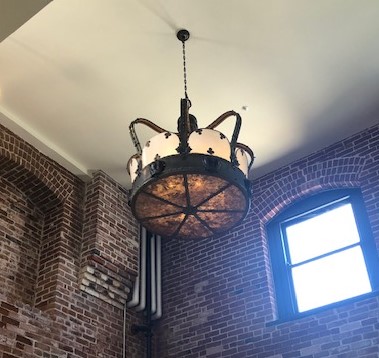
Image by PortiaLily Taylor
With regard to the dazzling environment, Baum said, “… those who do not find Coronado a paradise have doubtless brought with them the same conditions that would render heaven unpleasant to them, did they chance to gain admittance.”
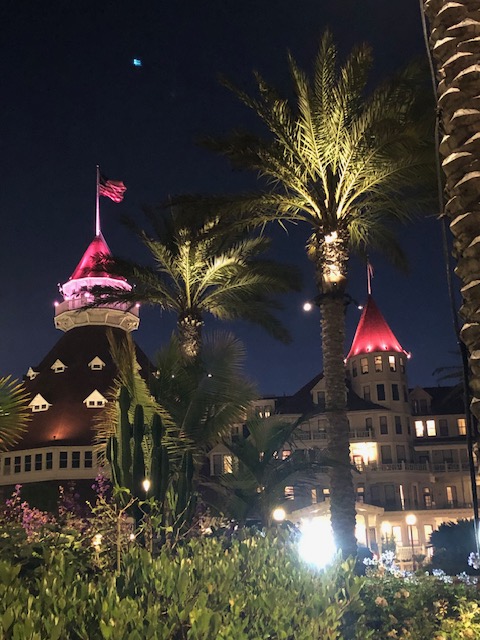
Image by PortiaLily Taylor
Staying at the hotel allowed me to experience the “paradise” Baum described since its structure remains much the same as it was during the author’s residence. First completed in 1887, “the Del” is a vision of red-roofed turrets and white-painted redwood. It’s not difficult to imagine Dorothy and Toto running through its gardens out to the sandy beach.
House on Star Park Circle
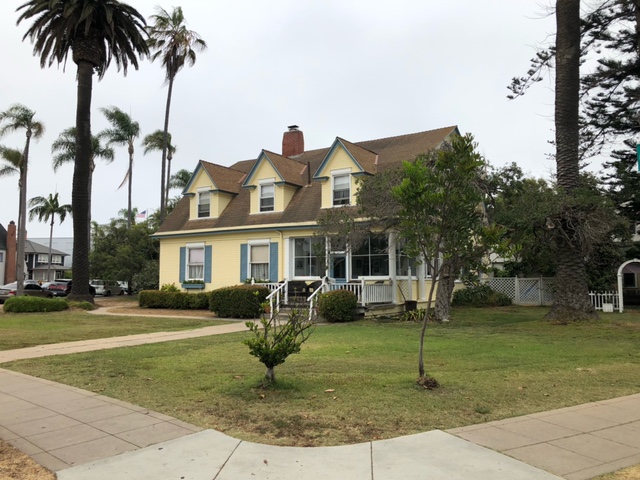
Image by PortiaLily Taylor
Later the Baums rented a house on Star Park Circle not far from the del Coronado Hotel. There Baum wrote several Oz books: Dorothy and the Wizard of Oz, The Emerald City of Oz, The Road to Oz, and parts of The Marvelous Land of Oz. The yellow house still stands as a private Coronado residence.
Coronado Museum of History and Art
This small museum is housed in Coronado’s first bank building. Three first-edition Baum books are on display: Dorothy and the Wizard of Oz, The Emerald City of Oz, and The Road to Oz. There is also a photo of Baum in a Coronado park. Several books about Coronado are on sale at the museum’s bookstore. I purchased Crown City by the Sea by Jennifer M. Franks. It is a fictionalized version of the founding of Coronado and the Hotel del Coronado with references to actual people involved in this history including Baum.

Image found at https://www.sandiego.org/articles/arts-culture/seven-spots-to-see-classic-art.aspx
Coronado Public Library
The entrance to the children’s section of Coronado’s public library displays nine glass panels that celebrate Baum’s ties to the community. The colorful panels feature the likenesses of Dorothy, Cowardly Lion, Scarecrow, Tin Man and Wicked Witch. They were unveiled in 2006 on what would have been Baum’s 150th birthday. The library also offers the centennial edition of “The Annotated Wizard of Oz” with an introduction by Michael Patrick Hearn, a leading Oz scholar.
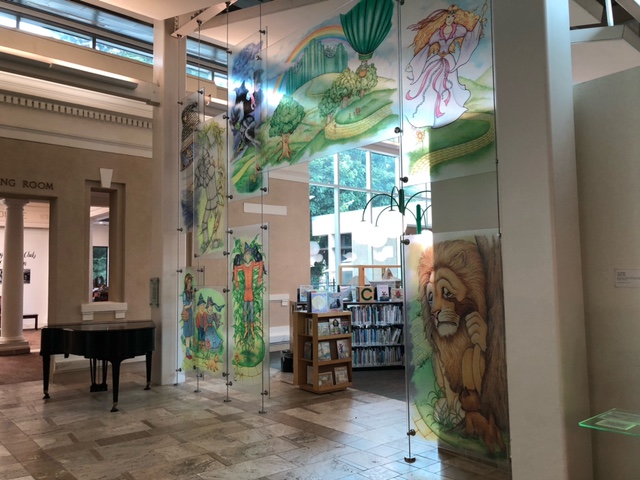
Image by PortiaLily Taylor
CORONADO: “The Queen of Fairyland”
In 2019, Merrie Monteagudo wrote an article for The San Diego Union-Tribune that took information from the paper’s archives about Baum at Coronado. It can be found at https://www.sandiegouniontribune.com/news/local-history/story/2019-06-12/from-the-archives-l-frank-baum-at-coronado.
Monteagudo included a poem by Baum about Coronado and the related introduction that was published by the paper in 1905. It read, “Mr. Baum’s ode to “Coronado, Queen of Fairyland,” is not the burst of admiration accompanying a sudden love affair, but the expression, in admirably chosen words, of the devotion of years. It takes Chicagoans to appreciate the attractions and comforts of life at Coronado, as Mr. Baum once more makes evident in his verses:
Coronado: The Queen of Fairyland
Let Coronado wear her crown
As Empress of the Sea:
Not need she fear her earthly peer
Will e’er discovered be.
We revel ‘neath her tropic palms
And scent her brilliant flowers
And fondly greet the song-birds sweet
That warble in her bowers.
And every day her loveliness
Shines pure, without a flaw;
New charms entrance our every glance
And fill our souls with awe!
To South the mountains rear their crests
Enveloped in a haze
Of shifting blues and violet hues
And rare and modest greys.
To Eastward San Diego’s heights
Stretch downward to the bay
Which coyly laves her with the waves
Wherein the dolphins play.
To North bold Loma’s rugged cliff
Leaps out in majesty
To where beside the rushing tide
Her beacon light we see.
The wonders of the setting sun
Confront us in the West
To glorify both sea and sky
And fire old Ocean’s breast.
And mortals whisper, wondering:
“Indeed, ’tis Fairyland!
For where is joy without alloy
Enchantment strange and grand.”
And tired eyes grow bright again,
And careworn faces smile;
And dreams are sweet and moments fleet,
And hearts are free from guile.
So wreathe fair Coronado’s brow
With laurels nobly won-
The nation’s pride, grim Ocean’s bride,
High Priestess of the Sun!”
Final Note from PortiaLily
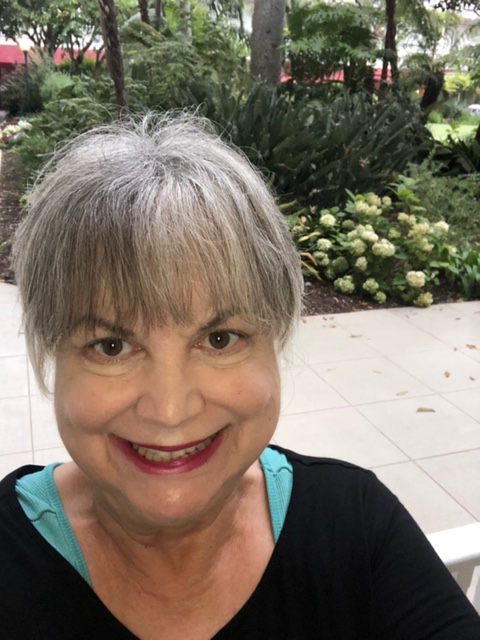
Selfie by PortiaLily Taylor in the Gardens of the del Coronado Hotel
One may gain much by following the words of Zac Thompson to “pay homage to artists who speak to us with startling directness across distances and decades.” I know I did. I thoroughly enjoyed my visit to Coronado and learning more of L. Frank Baum’s connection to this beautiful place. Just being in the city he loved and in which he wrote many of his books has inspired my own writing, especially Captain Con & the Red Jacket.
If you have a favorite author, I recommend visiting the places where they wrote. You, too, might be inspired to read more of their works or even be inspired to write yourself.
NOTE: Captain Con & the Red Jacket by PortiaLily Taylor is in the process of being edited. More information on its progress to publication will be coming. Also, if you wish to subscribe to PortiaLily’s newsletter, please email her at RoseRockBooks@gmail.com.

 PortiaLily Taylor
1 thought on ““Where They Lived & Scribbled” Series: Visiting Coronado, the Winter Home of L. Frank Baum”