


“And I rose In rainy autumn And walked abroad in a shower of all my days…” ~ Dylan Thomas from Poem in October
These words of Dylan Thomas from his Poem in October symbolize his reflecting on past experiences that impacted his life and self-awareness. As I, too, consider “a shower of all my days,” my own reflections include the role Dylan Thomas played in my early life.
Dylan Thomas was a Welsh poet, playwright, screenwriter, and author of books and radio broadcasts. He was extremely popular during his life with this popularity extending beyond his death in 1953 at the age of 39. His work garnered critical praise and honors. He “was a prodigy who became a living legend, the first poet to be magnified by celebrity culture – his words, voice, image and private life broadcast on an international scale through the 20th Century’s new media of radio, television, film and audio recordings.” [from “Dylan Thomas: Rock N’ Roll Poet” by Jane Ciabattari found at https://www.bbc.com/culture/article/20141016-dylan-thomas-rock-n-roll-poet]
Click on this link https://youtu.be/EnoHCSU5yn8 to hear Dylan Thomas reading his Poem in October.
I discovered Dylan Thomas when I was in high school. My primary interests involved being on the school debate team and speech & drama club. Through those activities, I attended many speech tournaments. However, I wanted to expand beyond debate and oratory at those tournaments. I decided to enter “Poetry Reading.” But the poetry we studies in English class like the Song of Hiawatha by Longfellow or Ode to a Grecian Urn by Keats wouldn’t cut it. I needed something more dramatic, more lyrical, and more interesting. I had already gotten in trouble for reciting Bob Dylan when my English class was asked to read poetry that we selected on our own. “That’s not poetry,” my teacher scolded. I tried to use my debate skills to argue my position. That only got me in more trouble. Then I remembered some research I did for my ill-fated Bob Dylan project, I learned he chose the name “Dylan” in honor of Dylan Thomas. So I decided to read that Dylan’s poetry and select his work to recite at the next speech tournament.
Fern Hill and Do Not Go Gentle into That Good Night spoke to me, and, thus, I prepared those two poems for recitation. Of course, my reading did not compare to hearing the author recite his own work.
With much teenage enthusiasm, I spoke the words of the Welsh poet and won first place in poetry at the tournament. That award qualified me for the regional speech competition on my way to the state-wide event. I was excited! However, I soon learned an unexpected lesson. Some people’s prejudices have nothing to do with logic…or talent. The judge assigned to my preliminary section placed me last in the category. His single comment on my judging sheet was “Females should never recite Dylan Thomas!”
Really? I found it hard to believe, as did my coach. However, her protests were not heeded, Nothing was done, and that was the end of my attempts at poetry recitation, but not my efforts in areas then considered “off limits” for females or my love of Dylan Thomas poetry.
As I continued to read and appreciate the Welsh poet, I wanted to visit places where he “lived and scribbled” pursuant to the words of Zac Thompson that I’ve quoted in past posts. Thompson stated, “Though the best way to engage with great authors of the past is, of course, to read their work, there’s plenty to gain from visiting the places where they lived and scribbled. Touring writers’ preserved homes can help put their books in historical context or fulfill a quasi-religious need to pay homage to artists who speak to us with startling directness across distances and decades.” [His article is found at https://www.frommers.com/slideshows/848441-writers-in-residence-how-to-visit-where-great-american-authors-lived-and-worked.]
The first opportunity I had to visit a pIace important to Dylan was when I studied one summer at Magdalen College in Oxford. During one weekend, I traveled to Swansea, Wales to see where Thomas “lived and scribbled.” He was born in what I would describe as a middle-class townhouse in the Uplands district of Swansea on October 27, 1914. He spent his first twenty years in this house and wrote many poems there.

IMAGE: Hywel Williams, CC BY-SA 2.0 https://creativecommons.org/licenses/by-sa/2.0, via Wikimedia Commons
Later that day, I walked 5 ½ miles to the near-by village of Mumbles. Young Dylan spent time at this lovely spot by the sea. As I walked, I wondered if the buildings, boats, and trees I passed might have seen by Dylan on his way years before. I could imagine the poet’s childhood outings there. Later Dylan would act with the Swansea Little Theatre in a Mumbles church hall. The local beaches and promontory were featured in Dylan’s autobiographical collection Portrait of the Artist as a Young Dog. Mumbles and its pier were filled with lights and rides when I visited. The carnival atmosphere was appropriate for my celebration and remembrance of Dylan.

IMAGE: Paul Lakin, CC BY 3.0 https://creativecommons.org/licenses/by/3.0, via Wikimedia Commons
Magdalen College was not only the place where I studied law that summer. It was the place where Dylan and his wife Caitlin lived in 1946. They were guests of Dylan’s patron Margaret Taylor at the summerhouse of Holywell Ford in the grounds of Magdalen College. From there, Margaret found the couple another Oxford residence, the Manor House at South Leigh. Dylan liked to visit the local pubs. My favorite pub and restaurant in the area was The Trout at Wolvercote. I hope Dylan enjoyed the food and drink there as much as I did!

IMAGE: Holywell Ford in the grounds of Magdalen College, Oxford, JCrue, CC BY-SA 4.0 https://creativecommons.org/licenses/by-sa/4.0, via Wikimedia Commons
A few years later, I continued my homage to Dylan during a trip to New York City. Of course, I had to stay at the Chelsea Hotel since it was where the poet frequently lived during his later years. But my stay at the Chelsea was some time ago—before the neighborhood’s gentrification. The premises was still in its “Sid and Nancy” era of artists and excess. I didn’t care. All I could do was wonder what the hotel was like when Dylan lived there—or its other residents like Mark Twain, Allen Ginsburg, Madonna, and Jim Morrison.

IMAGE: Eden, Janine and Jim from New York City, CC BY 2.0 https://creativecommons.org/licenses/by/2.0, via Wikimedia Commons
Thomas’ North American reading tours and stays at the Chelsea began in 1950. Unfortunately, during those years his hard drinking grew worse. He frequented many bars around the hotel. I visited one of them during my trip, the White Horse Tavern. Dylan was on a monumental drinking binge at the White Horse shortly before he was taken ill and carried back to the Chelsea where he collapsed. He was taken to St. Vincent’s Hospital where he died on November 9, 1953. His last words were said to be ““I’ve had eighteen straight whiskies – I think that’s a record!”
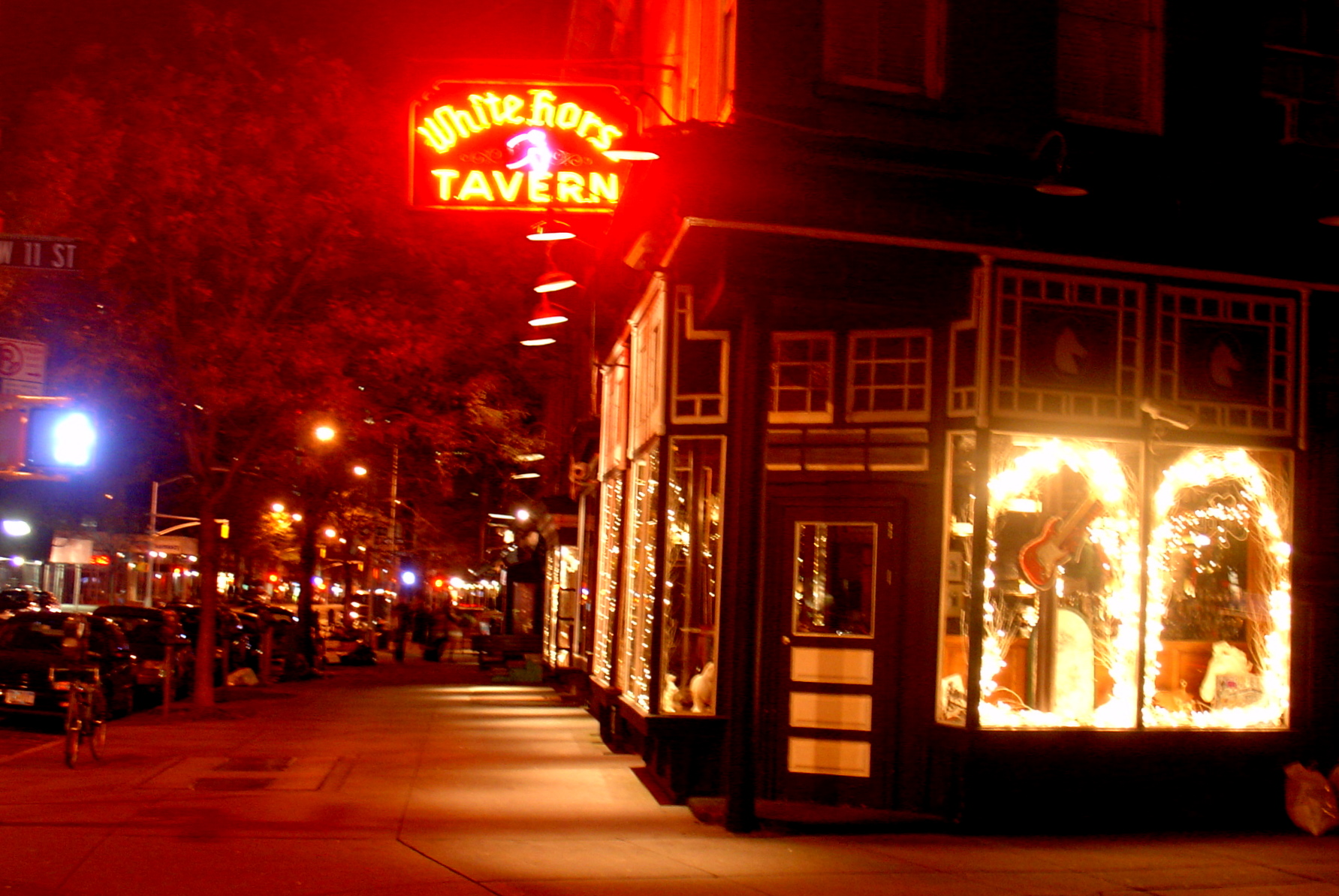
IMAGE: Johndhackensacker3d, CC BY-SA 3.0 <https://creativecommons.org/licenses/by-sa/3.0>, via Wikimedia Commons
It is sad to think the life of such a great writer ended this way. But, his words and his work live on. A plaque in his honor is in the Poets’ Corner of Westminster Abbey.
Dylan was buried at, perhaps, the most iconic place associated with him—Laugharne. There, he and Caitlin lived in “the Boathouse” for the last few years of his life before his final visit to New York City. An old, wooden garage was transformed into Dylan’s “Writing Shed.” For more insight into Dylan at Laugharne, I suggest Charlotte Peacock’s article found at https://charlottepeacock.co.uk/2021/01/25/dylan-thomas-boathouse/.
There are so many more places where Dylan “lived and scribbled.” I suggest reading the article found at https://www.discoverdylanthomas.com/the-essential-guide-to-dylan-thomass-places. Note that the website is from Hannah Ellis, granddaughter of Dylan Thomas.

IMAGE: The Boathouse at Laugharne found at http://www.discovery.sites.k-hosting.co.uk/wp-content/uploads/2015/04/laughbtview.jpg
***
I read Dylan’s poetry and think of the places I visited where he “lived and scribbled.” I wonder what was in my teenage-mind to select Fern Hill, a poem of youthful exuberance, and Do Not Go Gentle into That Good Night, a poem that charges one to keep that exuberance into old age. As I reminisce “in a shower of all my days,” as Dylan wrote, the words of those two poems I recited so long ago are even more meaningful and dear.
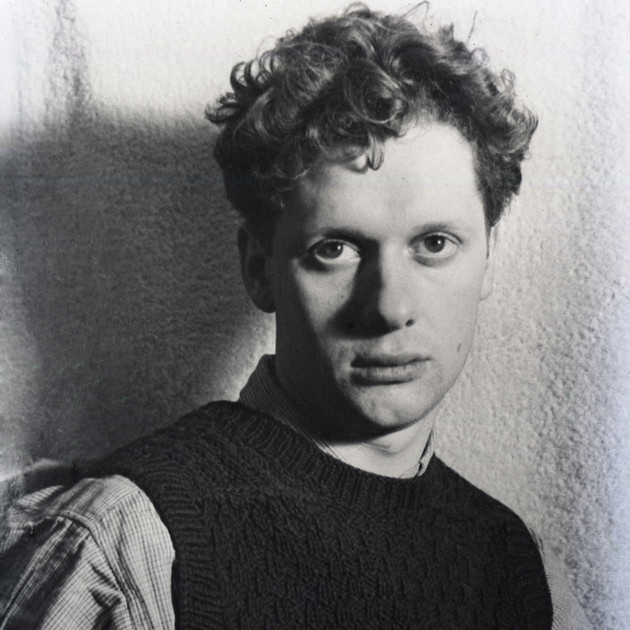
Title Image found at https://art-sheep.com/wp-content/uploads/2015/07/26_dylan_thomas.jpg

 PortiaLily Taylor

1 thought on “Visiting Iconic Locations Where Dylan Thomas “Lived & Scribbled” by PortiaLily Taylor”