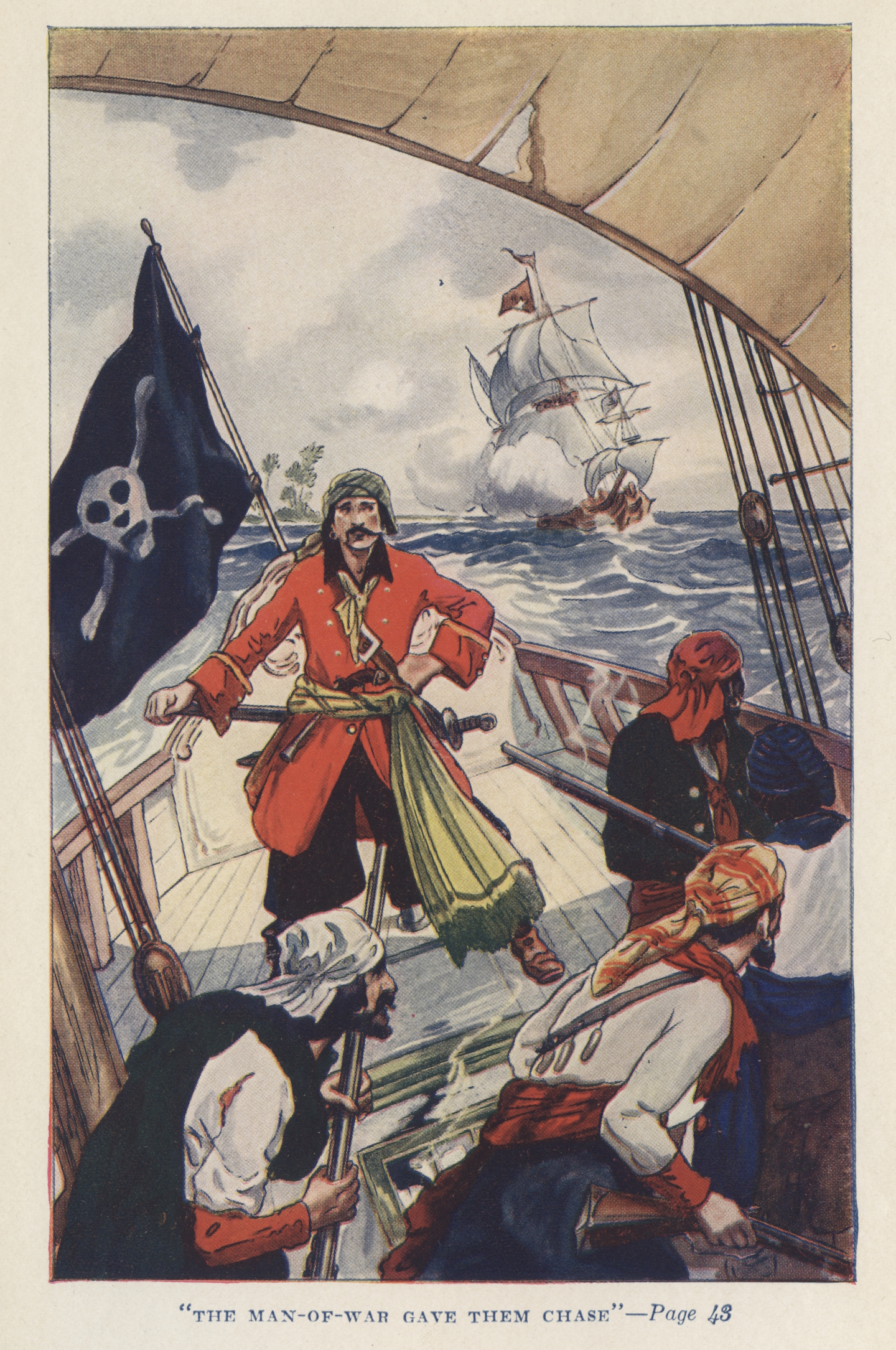
Image in the public domain, available via Project Gutenberg
Ahoy, Mateys!
September 19th is the day that encourages you to “talk like a pirate,” while many books including my novel Captain Con and the Red Jacket give you (and young readers) the opportunity to “read about a pirate.”
Talk Like a Pirate
In 1995, John Baur and Mark Summers were playing racquetball when one shouted “aarrr!” after an injury. That utterance gave the two friends the idea of creating a day when people could sprinkle “pirate speak” into daily conversations. That day was to be September 19th, the birthday of Summers’ ex-wife. In 2002, they sent a letter about their fictional holiday to author and columnist Dave Barry who wrote an article promoting the event. Soon after Talk Like a Pirate Day became an occasion celebrated in mainstream pop culture.
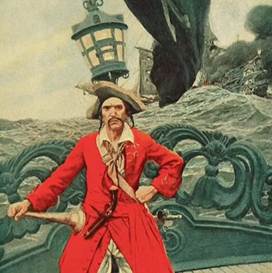
Captain Keitt, a detail from the frontispiece of The Ruby of Kishmoor, written and illustrated by Howard Pyle (1853-1911). First published in 1908/ Image via Wikimedia Commons
How did pirates actually talk?
The Golden Age of Piracy lasted from the mid-1650s to the 1730s. Of course, no recording of pirates speaking exist from that era. So, we don’t know exactly how pirates talked. We do know that pirates during that time period came from many areas—America, the Caribbean, Europe, Africa. As a result, there wasn’t one “pirate talk” accent or language as shown through the pirates mentioned below.
Edward Teach, known as Blackbeard, was most likely from Bristol, England, although some suggest he was born in colonial South Carolina. It is theorized that he would have spoken with an 18th-century West Country English accent with the “r” sound strongly pronounced. Sailing alongside Blackbeard was Black Caesar, a famous West African pirate. He likely spoke native West African languages, combined with maritime English or Spanish. Anne Bonny was from Cork, Ireland. She probably spoke Irish English and local Munster dialects later blended with colonial American and Caribbean accents. The Golden Age pirate Thomas Pound was born in Boston, Massachusetts. He was said to be well-spoken with an early colonial American accent close to the English dialects of the Puritans.
Since pirates of the Golden Age of Piracy were from many countries and spoke many languages, they often spoke a hybrid of those tongues known as Maritime Pidgin English or Ship English. Without that creation, life on pirate ships would have been difficult. Pidgin had simple grammar that combined West African, British, Spanish, French, and indigenous languages. For example, “dash” was a West African pidgin term used to mean a tip, bribe, or payout.
Of course, pirates didn’t only roam the seas of the West during this time period and beyond. A massive 19th-century Chinese pirate confederation dominated the South China Sea with its Red Flag Fleet under the command of Pirate Queen Ching Shih and pirate commander Zheng Yi, her husband. At its height, the fleet had 1800 ships and over 80,000 pirates. Ching Shih was from the coastal Chinese province of Guangdong, so her native tongue would have been Cantonese, although she may have also spoken the local coastal dialects of her crews.
How did what we think of as “pirate talk” come about?
Modern ideas regarding how we think pirates of the Golden Age of Piracy talked came, not from historic sources, but from Hollywood.
Robert Louis Stevenson’s 1883 novel Treasure Island popularized pirates and their adventures. When Disney used that novel for the foundation of its movie of the same name, “pirate talk accent” was born. British actor Robert Newton, who played Long John Silver in the film, exaggerated his own English West Country accent in his dialogue. Because of the movies, we now associate phrases like “shiver me timbers,” “walking the plank,” and “arr, matey!” to pirates.
Many websites include a list of pirate terms and their meanings. One such site, YourDictionary.com, has a list of pirate vocabulary at https://www.yourdictionary.com/articles/pirate-terms. Included in that website’s pirate words and phrases are:
- blimey – something said when one is in a state of surprise
- briney deep – the ocean
- hearties – friends and comrades
- heave ho – instruction to put some strength into whatever one is doing
- landlubber – a person who is uncomfortable, or not incredibly skilled, at sea
- lily-livered – an insult for someone who displays cowardice
- Savvy? – a question that means, “Do you understand?”
- scurvy dog – an insulting name
- son of a biscuit eater – an insult
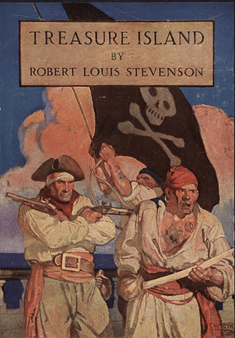
Treasure Island book cover, 1911 Scribner edition, N. C. Wyeth/ Image in public domain, available via Wikimedia Commons
Read about a Pirate
Pirates in the Golden Age were often democratic in how they organized and led themselves. However, they were also violent outlaws who operated out of economic desperation. Their depictions in literature don’t always reflect their reality. Regardless of the failure to follow the facts, pirate stories are usually filled with adventure and quite fun to read.
What are Some Books about Pirates?
Pirates have been characters in a host of books. Perhaps, the most well-known is Long John Silver. He first appears as the secret pirate leader in Treasure Island by Robert Louis Stevenson, published in a magazine in 1881-1882 and then as a novel in 1883. Stevenson created many pirate stereotypes in his novel such as Silver’s peg leg and shoulder-sitting parrot. He also gave his characters origins in the English West Country that led to the “pirate accent” and popularized signature phrases like “dead man’s chest” and the singing of nautical shanties.
Some popular tales that include pirates started as plays or movies and then became books. Peter Pan by J.M. Barrie began as a play in 1904 before the author wrote the story of Peter, Wendy, the Lost Boys, and Captain Hook as a novel in 1911. The story continues to inspire writers. One novel inspired by Peter Pan I especially enjoyed is Peter and the Starcatchers by Dave Barry and Ridley Pearson, published by Hyperion Books for Children in 2004. The book introduces the pirate Black Stache. In addition, the authors wrote four sequels and a series of chapter books, Never Land Adventures. A Broadway play with music was based on Barry’s and Pearson’s novel.
The unforgettable pirate Jack Sparrow was first brought to life through Pirates of the Caribbean series of five films. Their impact on pop culture led to the publication of several books based on the story of the movies. Targeting younger audiences are several “junior novelizations” by authors like Irene Trimble and Elizabeth Rudnick and published by Random House and Disney Press. A novel written for adults by A.C. Crispin, Pirates of the Caribbean: The Price of Freedom, is a prequel about Jack Sparrow’s early adulthood and his backstory with the East India Trading Company.
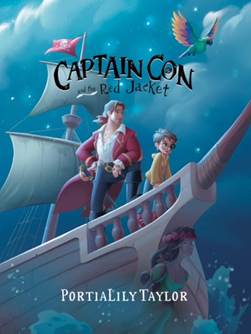
Book cover of Captain Con and the Red Jacket by PortiaLily Taylor, by illustrator and artist Michelle Savoia, published by Lawley Publishing Company
Captain Con and the Red Jacket
My love for a good pirate yarn encouraged me to write my own pirate adventure, Captain Con and the Red Jacket. It’s a middle grade novel that follows the adventures of twelve-year-old Nick Grant-Caswell who mysteriously finds himself in a colorful and dangerous world of the pirate crew of the sailing ship, the Red Jacket. Here, Nick isn’t a bullied seventh grader. He’s The Other, the person foretold by the mysterious Princess Valencia to lead the captain and his crew to freedom from the evil Baron von Mal. To do so, Nick must face treacherous adventures and learn to believe in his new friends and himself.
In my book, Captain Con and his pirate crew are the good guys trying to escape the tyrant who’s attempting to control their entire world. Like the anime One Piece, my pirates fight corrupt authority, and that makes them heroes, not villains.
Since many of my characters are pirates, I wanted their speech to reflect the unusual vocabulary many perceive to be the way pirates would speak, especially since they appear as characters in a children’s book.
I embarked on this effort in the same way I would for a character whose first language isn’t English. I included “pirate” words and phrases in their dialogue. To help me in the process, I used different translation websites that could transform my American English into Pirate Speak. And that process was a lot of fun!
Two such websites are LingoJam (https://lingojam.com/PirateSpeak) and Pirate Monkeyness (https://pirate.monkeyness.com/translate). Here are examples of American English translated to Pirate Talk through these sites.
- LingoJam
Take a chance, friend, and read the adventures of the good pirates of the sailing ship the Red Jacket.
translated to…
Take a chance, mate, an’ read the adventures o’ the jolly gentlefolk o’ fortune o’ the sailin’ ship the Red Jacket.
- Pirate Monkeyness
Stop! Don’t go to the ship! The evil men of the Baron’s navy are hiding in the hold waiting to capture you and put you in jail.
translated to…
Avast! Don’t go t’ the ship! The evil scallywags o’ the Baron’s navy be hidin’ in the hold waitin’ t’ capture ye ‘n put ye in the brig.
Read My Pirate Adventure
My middle grade novel (Captain Con and the Red Jacket by PortiaLily Taylor, illustrations by Michelle Savoia) is available through online retailers beginning on October 20, 2026 for the hardcover and January 21, 2027 for the paperback. Check out some of the great purchase options:
- BarnesandNoble.com
- Click here to buy hardcover edition of Captain Con and the Red Jacket from Barnes and Noble
***
I hope you and your young reader friends, students, and family members have lots of fun talking like a pirate and reading about a pirate!
Enjoy the voyage ‘n fair winds t’ ye!
PortiaLily
© 2026, PortiaLily Taylor